
Email deliverability decides whether your campaign reaches the inbox, the promotions tab, the spam folder, or nowhere at all. If you are searching for how to improve email deliverability, start by fixing the trust signals and list habits that mailbox providers actually measure.
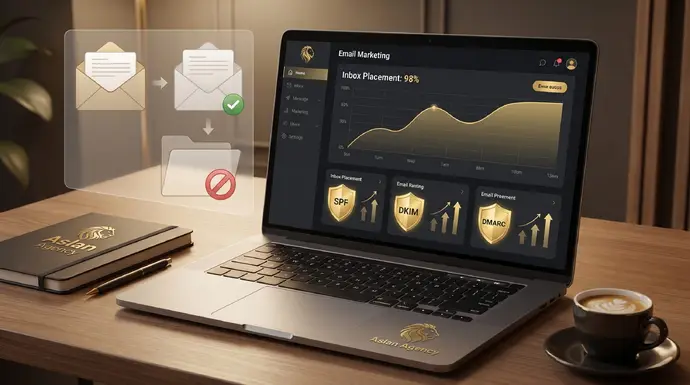
Email deliverability decides whether your campaign reaches the inbox, the promotions tab, the spam folder, or nowhere at all. If you are trying to figure out how to improve email deliverability, the answer is usually not one magic fix. It is a system: domain authentication, list quality, sending consistency, complaint control, and content that matches what subscribers actually signed up to receive.
That matters more now because mailbox providers have tightened enforcement, and a lot of senders are still behind. Google requires senders to keep spam rates reported in Postmaster Tools below 0.3%, and bulk senders need SPF, DKIM, and DMARC in place. Yahoo mirrors that 0.3% complaint threshold and also expects proper authentication and unsubscribe support. Microsoft has also raised the bar for high-volume senders with stricter SPF, DKIM, and DMARC requirements.
So if your opens are falling, replies are disappearing, or campaigns are landing in spam, this guide breaks down how to improve email deliverability in practical terms. You will learn what to fix first, what metrics to watch, and how to build a sending setup that mailbox providers trust.
How to improve email deliverability with sender authentication
If you want the fastest answer to how to improve email deliverability, start with technical trust signals. Mailbox providers want proof that your domain is authorized to send the message and that it has not been altered in transit. That is where SPF, DKIM, and DMARC come in.
Google's email sender guidelines require all senders to use SPF or DKIM, and bulk senders must use both SPF and DKIM while also publishing DMARC. Yahoo says bulk senders should publish a valid DMARC policy with at least p=none and keep the From domain aligned with SPF or DKIM. Microsoft announced similar rules for domains sending more than 5,000 messages per day.
In plain English, your DNS records need to be clean and current. If you use Klaviyo, Mailchimp, HubSpot, ActiveCampaign, or another ESP, do not assume the defaults are enough. Audit every sending domain and subdomain. Make sure the right sending services are included in SPF, confirm DKIM is signing correctly, and publish a DMARC record that lets you monitor failures.
- SPF tells providers which servers are allowed to send on behalf of your domain.
- DKIM adds a cryptographic signature to prove message integrity.
- DMARC ties alignment together and tells mailbox providers how to handle failures.
Even if your campaigns are relatively small, getting this right helps build a stronger reputation over time. Authentication is no longer optional hygiene. It is the baseline for inbox placement.
How to improve email deliverability with list hygiene
Bad lists ruin good campaigns. You can write a strong subject line, send from a warmed domain, and still miss the inbox because too many of your recipients are invalid, inactive, or disengaged. One of the clearest ways to improve email deliverability is to send to fewer people, but send to the right people.
Higher Logic's summary of Google and Yahoo requirements notes that senders should maintain complaint rates below 0.1% and avoid exceeding 0.3%. The same guidance highlights list hygiene and bounce management as core compliance practices. Mailbox providers read negative engagement fast. If people ignore, delete, or report your emails, your future campaigns are more likely to suffer.
Start with these list hygiene actions:
- Remove hard bounces immediately.
- Suppress subscribers who have not engaged in a meaningful period.
- Use confirmed opt-in for high-risk acquisition sources.
- Never buy lists or scrape contacts.
- Review form sources to find where low-quality leads are entering your database.
This is also where segmentation helps. Sending the same message to everyone increases the odds that part of your audience will tune out. A tighter segment usually performs better, which strengthens engagement signals and reputation at the same time. If you already have content focused on growing the right audience, this pairs naturally with building an email list from social media in a way that attracts better subscribers from the start.
How to improve email deliverability by watching complaints, bounces, and engagement
A lot of teams focus on open rate and miss the bigger picture. That is too narrow. Deliverability depends on a set of signals that tell mailbox providers whether recipients welcome your mail.
Google says spam rates in Postmaster Tools should stay below 0.3%. Yahoo uses the same 0.3% ceiling in its sender requirements. Outlook explicitly calls out list hygiene and bounce management as part of its recommendations for high-volume senders. Those thresholds matter because they are direct inputs into reputation.
Here are the numbers worth watching every send:
- Spam complaint rate - Aim well below 0.1% and treat 0.3% as a hard danger zone.
- Hard bounce rate - Keep it as low as possible. Spikes usually point to poor list quality or capture issues.
- Unsubscribe rate - A rising rate can signal mismatched expectations or too much volume.
- Click rate - Useful because it reflects real engagement better than opens alone.
- Inbox placement - Use seed testing or deliverability tools when possible instead of assuming delivery equals inbox placement.
If complaint or bounce rates climb, slow down and diagnose before sending again. Check recent acquisition sources, message frequency, and whether you changed sending infrastructure. Sometimes the issue is the audience. Sometimes it is a broken setup. Either way, the fix starts with measurement, not guesswork.
How to improve email deliverability with smarter sending volume and cadence
Mailbox providers do not just judge what you send. They judge how you send it. Sudden spikes in volume, especially from a newer domain or underused subdomain, can look suspicious even if your content is legitimate.
Google's FAQ says any sender that hits roughly 5,000 messages to personal Gmail accounts in a 24-hour period is considered a bulk sender, and that status does not expire. That means once you cross the threshold, you should operate like a sender under stricter scrutiny every time.
To improve deliverability, keep your sending cadence predictable. Warm up new domains gradually. Avoid going from occasional sends to large blasts overnight. If you are launching a new nurture sequence or seasonal promotion, ramp volume in steps rather than all at once.
Frequency also matters. If your list signed up for weekly content and you suddenly start emailing daily, complaint rates can rise even if the emails are technically sound. Yahoo specifically warns senders not to increase cadence beyond what subscribers expected. Respecting user intent is part of reputation management.
If your content calendar is inconsistent, it can help to systemize your planning the same way you would with a content calendar. Consistency is easier to maintain when campaigns are planned instead of rushed.
How to improve email deliverability with better content and unsubscribe experience
Technical setup gets you into the game, but the message itself still influences whether you stay in the inbox. Providers pay attention to user behavior, so content that feels misleading, irrelevant, or difficult to opt out of can damage performance.
Google requires one-click unsubscribe for marketing and subscribed messages sent by bulk senders. Yahoo requires easy unsubscribe, including a functioning list-unsubscribe header for bulk senders and a visible unsubscribe link in the message body. Those are not just compliance tasks. They reduce frustration and lower the chance that someone clicks Report Spam instead.
On the copy side, focus on clarity over tricks. Avoid bait subject lines that overpromise. Match the message to the signup source. Make sure the From name is recognizable. If someone joined for educational tips, do not surprise them with a hard sales sequence right away.
Good deliverability content practices usually include:
- Clear subject lines that match the actual email.
- Simple formatting and clean HTML.
- Obvious sender identity.
- One primary goal per email.
- An easy unsubscribe path.
Inbox providers reward consistency between promise and experience. That is one reason lifecycle and retention messaging tends to perform better when it is segmented instead of blasted.
How to improve email deliverability over time with a repeatable process
If you are serious about how to improve email deliverability, do not treat it like a one-time cleanup project. Treat it like ongoing channel maintenance. The strongest programs review domain health, list quality, engagement, and campaign performance every month.
A practical process looks like this:
- Monthly technical audit - Verify SPF, DKIM, DMARC, DNS, and sending-domain alignment.
- List health review - Remove invalid contacts, suppress unengaged segments, and inspect signup sources.
- Engagement review - Compare complaint, unsubscribe, click, and bounce trends by segment.
- Cadence review - Check whether frequency matches subscriber expectations.
- Content review - Update templates, subject-line style, and unsubscribe experience.
This is where many small and midsize teams get into trouble. They focus on campaign production but not the infrastructure that keeps campaigns landing in the inbox. When revenue dips, they blame creative first when the real issue is reputation decay.
The upside is that deliverability problems are usually fixable. If you clean your list, authenticate your domain, reduce complaints, and send more relevant campaigns, you can recover meaningful inbox placement over time.
Final answer: how to improve email deliverability without chasing hacks
The best answer to how to improve email deliverability is to build trust with both mailbox providers and subscribers. That means authenticating your domain, keeping complaint rates low, cleaning your list, sending on a steady cadence, and making every email relevant to the person receiving it.
You do not need gimmicks. You need cleaner data, stronger sending practices, and content people actually want. Once those pieces are in place, better inbox placement becomes much more realistic and much more sustainable.