
Customer journey mapping gives you a clear view of how someone moves from first hearing about your business to becoming a repeat customer. For small businesses, that view matters because most lost sales do not happen in one obvious place. They happen in the gaps: a confusing offer page, a slow follow-up, an unclear next step, or a customer who likes you but never gets a reason to come back.
A good map does not need expensive software or a six-month research project. It needs honest customer input, clean data, and a willingness to fix the moments where people get stuck. This guide walks through how to build a useful journey map in 2026, what to include, and how to turn the map into better marketing decisions.
What customer journey mapping actually means
Customer journey mapping is the process of laying out the steps a customer takes before, during, and after buying from you. The map usually includes the customer's goal, the touchpoints they interact with, the questions they ask, the friction they feel, and the action you want them to take next.
Think of it as a customer-side view of your business. Your internal process might say: ad, landing page, lead form, sales call, invoice, delivery. The customer experiences it differently. They might see a social post, check your reviews, compare you with two competitors, ask a friend, open three emails, forget about you, come back through a retargeting ad, and finally book a call.
That messy path is the real path. Mapping it helps you stop guessing.
Salesforce describes journey mapping as a way to visualize the full customer experience, including actions, feelings, and touchpoints. That distinction matters. A spreadsheet can show traffic and conversions. A journey map shows why people hesitate, where they lose trust, and what information they need before taking the next step.
Why customer journey mapping matters for small businesses in 2026
Customer expectations keep rising, but small teams rarely have more hours in the week. That makes focus more important. Customer journey mapping helps you decide which marketing fixes are worth doing now and which ones can wait.
A Salesforce customer experience guide cites McKinsey research that companies using advanced customer experience analytics can see revenue gains of 5% to 10% and cost reductions of 15% to 25% within two to three years. A small business may not run enterprise analytics, but the principle still applies. Better customer insight leads to smarter fixes.
ClearVoice also summarized research showing that companies using both buyer personas and customer journey maps saw a 70% increase in conversion compared with companies using neither. Treat that number as directional, not a magic promise. The useful takeaway is simple: when you understand who you are talking to and what they need at each step, your marketing usually gets sharper.
Customer journey mapping also protects you from random marketing. Without a map, it is easy to blame the wrong thing. Low leads? You assume the ad is bad. Low close rate? You assume the salesperson needs a new script. Weak repeat purchases? You assume customers are not loyal. Sometimes those are true. Often, the real issue is a broken handoff between steps.
Customer journey mapping starts with one specific customer
The fastest way to make a bad journey map is to map every customer at once. A first-time buyer, a repeat customer, and a high-ticket lead do not move through the same process. Pick one customer type and one goal.
For example:
- A local service business might map a homeowner booking a consultation.
- An ecommerce shop might map a first-time buyer placing an order.
- A consultant might map a referral lead deciding whether to schedule a call.
- A creator or expert might map a follower joining an email list.
If you already have audience personas, use them here. If not, start with the customer group that produces the most revenue or has the most obvious friction. You can always map another segment later.
For businesses still shaping their audience, the brand voice guide can help clarify how customers should feel when they interact with your content. Voice is not the whole journey, but it affects every step of it.
The five stages of customer journey mapping
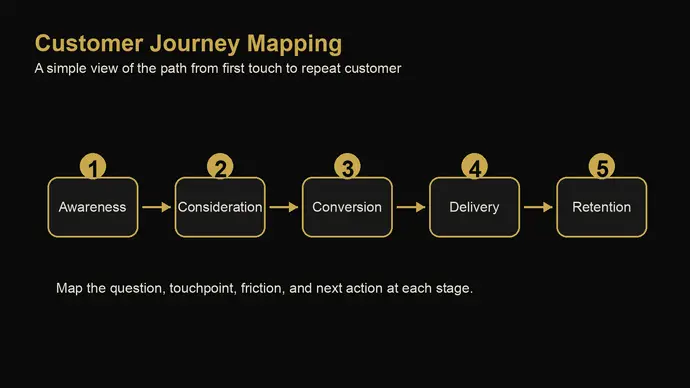
Most small business journeys can be organized into five stages: awareness, consideration, conversion, delivery, and retention. You can rename these if your business uses different terms, but do not overcomplicate the structure.
Awareness
This is where someone first notices you. The touchpoint might be a TikTok video, Instagram Reel, Google search result, referral, paid ad, blog post, podcast mention, or review site. At this stage, the customer is usually not ready for a hard pitch. They are trying to understand a problem, find options, or see who seems trustworthy.
Questions to ask:
- Where do new customers usually first find us?
- What problem are they trying to solve at that moment?
- What content earns attention without asking too much too soon?
Consideration
This is the comparison stage. Customers check your website, read reviews, scan testimonials, look at pricing, compare alternatives, and decide whether you feel credible. Small details matter here. A weak case study, outdated social profile, or vague service page can make a warm lead go quiet.
If you use proof content, read the guide on how to write a case study. Case studies are especially useful in this stage because they answer the question every buyer is quietly asking: can this work for someone like me?
Conversion
This is the point where the customer takes action. They book, buy, call, submit a form, request a quote, or subscribe. The job here is to remove friction. Make the offer clear. Make the next step obvious. Make response time fast.
Look for small blockers: too many form fields, unclear pricing, vague button copy, missing trust signals, weak mobile design, or no confirmation message after submission.
Delivery
The journey does not end when someone pays. Delivery is where expectations meet reality. If the onboarding email is confusing, the order update is late, or the customer has to ask what happens next, trust starts to leak.
Map this stage with extra honesty. Customers remember how easy or difficult it was to work with you.
Retention
Retention covers repeat purchases, referrals, reviews, renewals, upsells, and long-term loyalty. Many small businesses put almost all their effort into acquisition and almost none into retention. That is expensive. A simple follow-up sequence, review request, referral prompt, or customer education email can add revenue without increasing ad spend.
What to include in a customer journey map
A useful customer journey map does not need to be pretty. It needs to be specific. Use a table, whiteboard, spreadsheet, or document. Include these fields for each stage:
- Customer goal: what the customer wants at this moment.
- Touchpoints: where the customer interacts with you.
- Questions: what the customer needs answered.
- Emotions: what they may feel, such as curious, skeptical, confused, ready, frustrated, or reassured.
- Friction: what could slow them down or make them leave.
- Content needed: pages, posts, emails, videos, proof, FAQs, or scripts that would help.
- Business goal: the action you want them to take next.
- Metric: how you will know whether that stage is working.
Do not skip the emotion column. It can feel soft, but it is often where the best insights come from. A customer who is confused needs clarity. A skeptical customer needs proof. A rushed customer needs fewer steps. A customer who already trusts you needs a direct next action.
How to collect customer journey mapping data
Your map should be based on reality, not a conference-room guess. Start with the data you already have.
Look at website analytics to see which pages people visit before converting. Review form submissions and sales call notes. Read customer emails, support tickets, DMs, reviews, and comments. Ask recent customers what almost stopped them from buying. Ask lost leads why they chose another option.
GA4 can help you see user paths, traffic sources, high-exit pages, and conversion events. If your analytics setup is messy, the GA4 for small business guide is a good place to tighten the basics before drawing conclusions.
You do not need hundreds of responses. Five to ten honest customer conversations can reveal patterns that dashboards miss. Listen for repeated phrases. If three people say they were not sure what package to choose, you have a clarity problem. If several leads mention slow replies, you have a follow-up problem. If customers love the result but never leave reviews, you have a retention process problem.
Customer journey mapping example for a small service business
Imagine a small service business that wants more consultation bookings. The team gets decent traffic from social media and search, but bookings are inconsistent.
At the awareness stage, customers find short educational posts and local search results. The content gets attention, but most posts do not explain the next step. The fix: add clearer calls to action and create one guide that answers the most common beginner questions.
At the consideration stage, customers visit the service page and review page. They want proof, pricing context, and a reason to trust the business. The fix: add two short case studies, a better FAQ section, and clearer service outcomes.
At the conversion stage, customers fill out a form. The form has nine fields and no confirmation message beyond a generic thank-you page. The fix: reduce the form to five fields, add a confirmation email, and explain when they will hear back.
At the delivery stage, new customers receive a calendar invite but no prep instructions. The fix: send an onboarding email with what to expect and what to prepare.
At the retention stage, happy customers are not asked for reviews or referrals. The fix: add a follow-up email two weeks after completion with a review link and a simple referral prompt.
None of those fixes require a total rebrand or huge ad budget. They come from seeing the journey clearly.
Common customer journey mapping mistakes
The first mistake is making the map too broad. If the map tries to cover every customer, every product, and every channel, it becomes useless. Start narrow.
The second mistake is only mapping what the business does. A customer journey map should show the customer's thoughts and actions, not just your internal workflow.
The third mistake is treating the map as a one-time document. Customer behavior changes. Your offers change. Platforms change. Review the map at least once per quarter, or whenever you see a major change in leads, conversions, repeat purchases, or customer feedback.
The fourth mistake is ignoring post-purchase moments. Retention is often where the easiest money is. If customers like the result but never come back, never refer, and never review, the journey is unfinished.
Turn customer journey mapping into action
After you build the map, pick the three biggest friction points. Do not try to fix everything in one week. Rank each issue by impact and effort.
High-impact, low-effort fixes should go first. Examples include rewriting unclear button copy, adding a pricing note, improving a confirmation email, adding a review request, creating a simple FAQ, or making one landing page easier to scan on mobile.
Then assign one owner and one metric to each fix. If the issue is weak consultation bookings, track form completion rate and booked calls. If the issue is poor repeat purchase behavior, track repeat order rate or renewal rate. If the issue is low trust, track case study views, review clicks, and sales call objections.
This is where customer journey mapping becomes more than a diagram. It becomes a work plan.
Final take on customer journey mapping
Customer journey mapping helps small businesses see what customers actually experience. It shows where trust is built, where attention drops, where leads hesitate, and where repeat revenue is being left on the table.
Start with one customer type and one goal. Map the stages. Add real data. Find the friction. Fix the highest-impact gaps first. That simple process can make your marketing clearer, your follow-up stronger, and your customer experience easier to say yes to.