
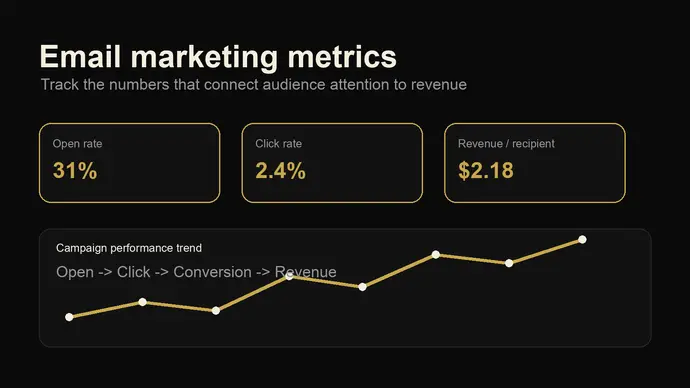
Email marketing metrics can tell you whether your list is actually creating revenue or just collecting opens. That difference matters. A campaign can look healthy in a dashboard and still fail to bring in leads, sales, booked calls, or repeat buyers. The better approach is to track a small set of numbers that connect inbox behavior to business outcomes.
This guide breaks down the email numbers worth watching in 2026, how to read them, and what to improve when the numbers start slipping. The goal is not to build a giant reporting spreadsheet. It is to make smarter decisions about your list, offers, content, segmentation, and follow-up.
Email marketing metrics that deserve your attention first
Most email platforms show dozens of numbers. Some are useful. Some are distractions. If you only look at open rate, click rate, unsubscribes, and revenue after every send, you will miss the deeper story. The best email reporting starts with one question: what was this email supposed to do?
A newsletter might be built to educate and keep your audience warm. A product launch email might be built to drive purchases. A reactivation email might be built to find out who still wants to hear from you. Those emails should not all be judged by the exact same scorecard.
Start with these core metrics:
- Delivery rate: the percentage of sent emails that actually reach recipient mail servers.
- Open rate: the percentage of delivered emails that register as opened.
- Click-through rate: the percentage of delivered emails that get at least one click.
- Click-to-open rate: the percentage of openers who click.
- Conversion rate: the percentage of recipients who complete the action you wanted.
- Unsubscribe rate: the percentage of recipients who opt out after a send.
- Spam complaint rate: the percentage of recipients who mark the email as spam.
- Revenue per recipient: revenue divided by delivered recipients.
That list gives you a full path from delivery to attention to action. If one stage drops, you know where to investigate instead of guessing.
Why email marketing metrics changed in 2026
Email reporting is less clean than it used to be. Apple Mail Privacy Protection can inflate opens by preloading tracking pixels, which means open rate is useful for direction but not perfect proof of attention. Gmail and Yahoo sender requirements also made authentication, complaints, and list hygiene harder to ignore. If your SPF, DKIM, DMARC, unsubscribe flow, and complaint rate are weak, performance can drop before your subject line even gets a fair chance.
Benchmarks also vary by platform and industry. WebFX reports an average open rate of 19.21% and click-through rate of 2.44% across industries in its 2026 benchmark data. Klaviyo, using data from more than 183,000 businesses, reports a 31% average campaign open rate and 45.1% for top performers. Those numbers are not contradictory. They reflect different datasets, industries, and tracking methods.
So do not treat a benchmark as a verdict. Treat it as context. If your open rate is lower than peers but your sales per recipient are strong, your email program may be healthier than it looks. If your open rate is high but clicks and conversions are flat, the subject line is doing more work than the offer.
For a practical foundation before you dig into the dashboard, pair this guide with our article on email marketing best practices. The metrics are easier to fix when the basics are already in place.
Open rate: useful, but easy to misread
Open rate measures attention at the top of the funnel. It is still worth watching because it can reveal patterns in subject lines, send timing, sender name, and list fatigue. But it should not be your main success metric.
A healthy open rate depends on the type of email. A small, loyal list may open at 45% or higher. A broad promotional list may sit much lower and still produce revenue. Automated flows often outperform one-off campaigns because the timing is based on behavior. A welcome email, abandoned cart reminder, or post-purchase follow-up reaches someone at a specific moment. That context matters.
If open rate is falling, check these items first:
- Subject lines may be too vague, too repetitive, or too promotional.
- The sender name may not be instantly recognizable.
- The list may include too many inactive subscribers.
- The send cadence may be too high for the value being delivered.
- Your emails may be landing outside the primary inbox.
Do not panic after one weak send. Look at the trend across several campaigns. A single underperforming subject line is normal. A three-month slide deserves a closer look.
Click rate: the metric that shows real intent
Click rate is often more honest than open rate. A click means the recipient saw enough value to take the next step. It tells you whether your offer, angle, call to action, and email structure are working together.
Low clicks usually come from one of four problems. The email may be interesting but not actionable. The call to action may be buried. The offer may not match the segment. Or the email may ask for too many different actions at once.
One simple fix is to give each email one main job. If the goal is to book a consultation, the email should build toward that. If the goal is to read a guide, the copy should make that guide feel worth the click. Secondary links are fine, but they should not compete with the main action.
Click-to-open rate can help diagnose the issue. If opens are fine but click-to-open rate is weak, the subject line got attention but the email body did not close the gap. If opens and clicks are both weak, the issue may start with list quality, deliverability, or positioning.
Conversion rate: where email marketing metrics meet revenue
Conversion rate is the bridge between email activity and business impact. A conversion could be a purchase, booked call, quote request, webinar signup, lead magnet download, reply, survey completion, or account activation. The action depends on the campaign.
This is where many email reports get thin. They show opens and clicks but fail to connect the email to what happened after the click. Without that connection, teams end up optimizing for attention instead of outcomes.
Use UTM parameters on your links. Set conversion events in GA4 or your CRM. Track which campaigns create qualified leads, not just traffic. If you sell products, track revenue per recipient and revenue per email, not only total sales. A campaign sent to 2,000 people that generates $4,000 is often stronger than a campaign sent to 40,000 people that generates $20,000, depending on list cost and audience quality.
For service businesses, the conversion path may take longer. Someone may click a case study today, reply next week, and book a call next month. That is why campaign reporting should include both immediate conversions and assisted conversions when possible.
List health metrics that protect long-term performance
Good email programs are not built only on clever copy. They are built on trust with subscribers and trust with inbox providers. That is why list health metrics matter.
Watch bounce rate, spam complaint rate, unsubscribe rate, inactive subscriber percentage, and engagement by segment. A growing list can still be getting weaker if the new subscribers do not open, click, reply, buy, or stay subscribed.
Here is a simple rule: if people stop engaging, give them a chance to re-engage before you remove them. Send a short reactivation sequence. Ask if they still want the content. Offer a preference center if you have one. If they still do not respond, suppress them from regular campaigns.
This protects deliverability and gives your reporting a cleaner signal. It is better to have a smaller list that responds than a bigger list that drags down every send.
Segmentation also improves list health. Subscribers who joined for one reason should not receive every message you send. A restaurant owner, fitness coach, realtor, SaaS founder, and ecommerce operator may all care about marketing, but not in the same way. Our guide to email segmentation strategy explains how to split your list without making the system too complicated.
Email marketing metrics by campaign type
One common mistake is judging every email by the same numbers. A weekly newsletter, nurture sequence, abandoned cart email, launch campaign, and re-engagement email each has a different job.
For newsletters, watch opens, clicks, replies, unsubscribes, and returning website visitors. For sales campaigns, watch clicks, conversions, revenue per recipient, and revenue by segment. For automated flows, watch completion rate, drop-off points, conversion rate, and revenue per flow recipient. For re-engagement campaigns, watch confirmation clicks, unsubscribes, spam complaints, and the number of inactive contacts removed.
Lifecycle emails deserve special attention. Klaviyo's 2026 benchmark report found that automated flows generated nearly 41% of email revenue from just 5.3% of sends. That is a reminder that timing and intent can beat volume. If your email program relies only on broadcasts, you may be leaving easy wins untouched.
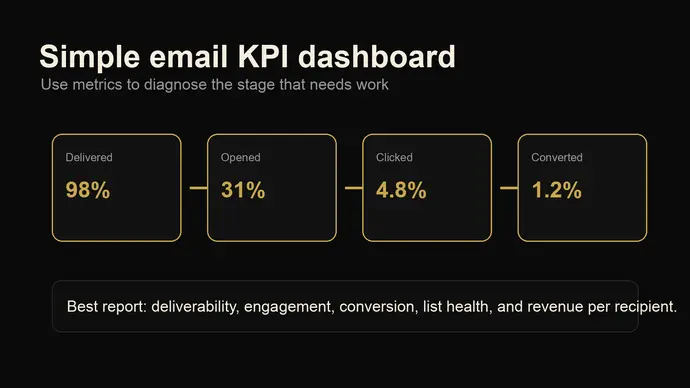
How to build a simple email marketing metrics dashboard
A useful dashboard should help you decide what to do next. It does not need to be pretty. It needs to be clear.
Build it around these sections:
- Audience: total subscribers, net growth, inactive subscribers, segment size.
- Deliverability: delivery rate, bounce rate, complaint rate, unsubscribe rate.
- Engagement: open rate, click rate, click-to-open rate, replies.
- Conversion: leads, purchases, bookings, revenue per recipient, assisted conversions.
- Learning: winning subject lines, top clicked topics, best performing segments.
Review campaign metrics after each send, but review strategy monthly. Daily checking can make normal variance feel like a crisis. Monthly reporting shows patterns: which segments respond, which offers convert, which topics earn clicks, and which automations quietly produce revenue.
If you only take one thing from this article, take this: separate diagnostic metrics from success metrics. Open rate and click rate diagnose behavior. Revenue, qualified leads, booked calls, and retention show business impact.
What to improve when your numbers are weak
When email performance drops, resist the urge to rewrite everything at once. Make one change at a time so you can learn from it.
If deliverability is weak, fix authentication, clean inactive contacts, reduce spammy wording, and slow down aggressive sending. If opens are weak, test sender names, subject lines, preview text, and timing. If clicks are weak, tighten the email around one action and make the offer more specific. If conversions are weak, check the landing page, checkout flow, booking page, or follow-up process. The problem may not be the email.
Keep a short testing log. Note the hypothesis, the change, and the result. Over time, that log becomes more useful than generic best practice lists because it reflects your audience.
The bottom line on email marketing metrics
Email marketing metrics are only useful when they lead to better decisions. A healthy report should tell you whether your list is reachable, whether people are paying attention, whether they care enough to click, and whether those clicks turn into business value.
In 2026, open rate alone is too shaky to carry your reporting. Use it as a directional signal. Put more weight on clicks, conversions, revenue per recipient, list health, and performance by segment. That mix gives you a clearer view of what is working and what needs to change.