
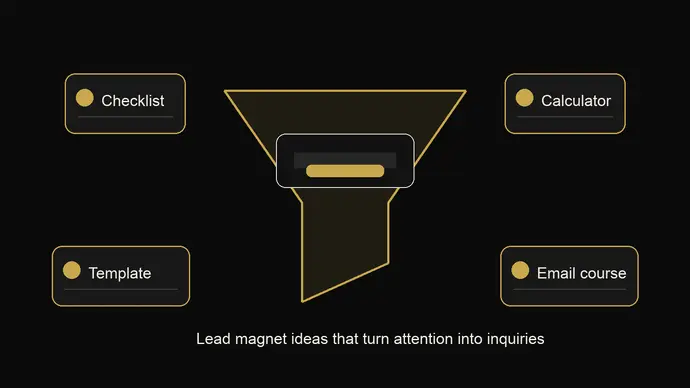
Lead magnet ideas are only useful if they attract the right person and make the next step easier. A generic PDF can add names to a list, but a useful lead magnet helps a potential customer solve one specific problem, then gives you a natural reason to keep the conversation going.
That matters because email and owned audiences still carry real weight. Mailchimp says its benchmark data is based on billions of emails sent through its platform. WebFX reports an average email open rate of 19.21% and a click-through rate of 2.44% across industries. HubSpot's marketing statistics also show content and lead generation remain closely tied, with blog posts still one of the most used content formats by marketers.
The lesson is simple: the offer has to earn the email address. People do not need another vague checklist. They need a fast win, a clear answer, or a tool they can use today.
Why lead magnet ideas work best when they solve one narrow problem
The best lead magnets are small. That sounds backward, but it is usually true. A 72-page guide feels impressive to the person making it. To the person downloading it, it often feels like homework.
A better lead magnet helps someone complete one job. If you run a bookkeeping service, that might be a tax document checklist. If you sell fitness coaching, it might be a seven-day meal planning template. If you help consultants get clients, it might be a proposal review worksheet.
Small offers work because they match the way people actually make decisions. They have a problem, they search for a fix, they test whether you understand them, and then they decide if you are worth hearing from again.
Before you pick a format, answer three questions:
- What problem does the buyer already know they have?
- What result can they get in less than 20 minutes?
- What paid service becomes the logical next step?
If you cannot answer the third question, the lead magnet may still be useful content, but it may not create qualified leads.
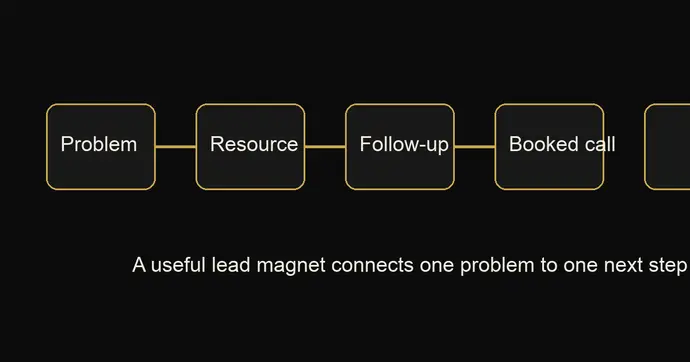
10 lead magnet ideas for service businesses
Use these as starting points, not templates to copy blindly. The right choice depends on the buyer's pain point, the complexity of your offer, and how much trust someone needs before booking a call.
1. Diagnostic checklist
A diagnostic checklist helps people find gaps before they talk to you. It works well for services where prospects know something is wrong but cannot name the cause.
Examples:
- Website conversion checklist for local service businesses
- Email deliverability checklist for ecommerce stores
- Hiring readiness checklist for founders
Keep it specific. A checklist called "Marketing Checklist" is too broad. A checklist called "15 things to fix before spending another dollar on ads" has a clear use case.
2. Calculator or scorecard
Calculators work because they give people a personalized answer. The output can be simple, but it should help someone see the cost of waiting or the size of the opportunity.
A social media consultant could offer an engagement scorecard. A financial coach could offer a debt payoff calculator. A marketing agency could offer a content ROI estimator.
This type of lead magnet also gives your follow-up emails useful context. Someone who scores low on consistency needs different advice than someone who scores low on conversion.
3. Template pack
Templates are strong lead magnets because they save time. They are especially useful for buyers who already believe they need to act but feel stuck on execution.
Good examples include:
- Welcome email templates
- Discovery call question templates
- Monthly content calendar templates
- Client onboarding email templates
The best template packs include short instructions. Do not just hand over a blank file. Show people where to customize it, what to avoid, and how to use it without sounding generic.
4. Swipe file
A swipe file gives people examples they can study. This works well when your audience wants inspiration but does not know what good looks like yet.
For example, a copywriter could offer "25 high-converting service page headlines." A social media strategist could offer "30 post hooks for consultants." An email marketer could offer "20 re-engagement subject lines."
Make sure the swipe file teaches patterns. If it is only a pile of examples, it is less useful. Add a short note under each example explaining why it works.
5. Mini audit
A mini audit can be manual or automated. It gives the prospect a quick view of what is working, what is missing, and what to fix first.
This is one of the strongest lead magnet ideas for high-trust services because it creates a direct bridge to your paid offer. A website designer can audit a homepage. An SEO consultant can audit a Google Business Profile. A content strategist can audit a company's last 10 posts.
The risk is time. If you offer a manual audit, set boundaries. Review one page, one account, or one metric category. Do not create a free consulting project disguised as a lead magnet.
6. Short email course
A short email course is useful when the buyer needs education before they are ready to buy. Instead of sending one file, you deliver one lesson per day for three to seven days.
This format works well for topics like list building, content planning, simple SEO, or customer retention. It also trains the subscriber to open your emails, which matters later when you send case studies, offers, and invitations.
Keep each lesson focused. One idea, one example, one action step. If the course feels like a textbook, people will stop reading by day two.
7. Buyer guide
A buyer guide helps people compare options. It is useful when your service is expensive, confusing, or easy to misunderstand.
For example:
- How to choose an email marketing platform
- What to ask before hiring a social media manager
- How to compare website redesign proposals
This type of guide positions you as helpful before the sales call. It also filters out poor-fit leads because serious buyers will recognize the level of thinking required.
8. Script or prompt library
Scripts help people move faster. A sales trainer could offer follow-up scripts. A recruiter could offer interview prompts. A content consultant could offer caption prompts or video outlines.
Prompt libraries are especially useful now, but they need a clear purpose. "100 AI prompts" is weak. "25 prompts to turn one blog post into a month of social content" is much stronger.
If you offer scripts, include notes on when to use them. Context keeps people from copying lines that do not fit their situation.
9. Resource list
A resource list is simple, but it can work if it saves the reader from sorting through bad options. The value is curation.
Examples include a list of recommended tools, a vendor comparison sheet, a content production stack, or a list of free analytics resources. This format works best when the reader trusts your taste and wants a shortcut.
Do not overdo affiliate links. If every recommendation feels paid, the lead magnet loses trust fast.
10. Case study breakdown
A case study breakdown teaches through a real example. It is different from a standard case study because it explains the decisions, not just the result.
If you use this format, show the starting point, the constraints, the strategy, and what changed. Readers should leave with a principle they can apply, even if they are not ready to hire you yet.
This pairs well with service businesses because it gives proof without turning the lead magnet into a hard pitch. For more on building proof, see our guide on how to write a case study that wins clients.
How to choose the right lead magnet ideas for your funnel
The format matters less than the buying stage. A person who just found your business may want a checklist or guide. A person comparing providers may want a calculator, audit, or case study breakdown.
Match the offer to the next step you want them to take:
- If you want newsletter subscribers, use a template, swipe file, or short email course.
- If you want booked calls, use a scorecard, audit, calculator, or buyer guide.
- If you want better-qualified leads, use a diagnostic tool that reveals fit.
You should also think about traffic source. Someone coming from a short social post needs a quick promise. Someone coming from a detailed blog post may be willing to download a deeper resource. If social media is your main traffic source, our guide on how to build an email list from social media is a useful next read.
One practical rule: your lead magnet should make the paid offer feel obvious, not random. If your service is email marketing, a welcome sequence template makes sense. A generic productivity planner probably does not.
Lead magnet ideas need a strong landing page too
A good lead magnet can still underperform if the landing page is unclear. The page should explain who the offer is for, what the reader gets, and why it is worth downloading now.
Keep the form short. For most top-of-funnel offers, name and email are enough. If you ask for phone number, company size, budget, and timeline too early, expect fewer signups.
Use a simple structure:
- Headline with the outcome
- Short explanation of the problem
- Bullets showing what is inside
- Simple form
- Privacy note or expectation setting
After the download, send people to a thank-you page with one next action. That might be reading a related article, watching a short video, or booking a consultation. Do not leave the subscriber at a dead end.
What to send after someone downloads your lead magnet
The follow-up sequence matters as much as the lead magnet. If someone downloads your resource and hears nothing for two weeks, the momentum is gone.
A simple five-email sequence is enough for most service businesses:
- Deliver the resource and explain how to use it.
- Share one mistake people make with the topic.
- Send a useful example or short case study.
- Answer a common objection.
- Invite the subscriber to take the next step.
This is also where segmentation helps. If someone downloaded a lead magnet about email list growth, do not immediately send them content about every service you offer. Stay close to the problem they raised their hand for.
How to measure whether your lead magnet ideas are working
Do not judge a lead magnet by downloads alone. A free resource with 1,000 low-quality signups may be worse than one with 80 serious prospects.
Track these numbers:
- Landing page conversion rate
- Email confirmation or deliverability rate
- First follow-up open and click rate
- Consultation bookings or reply rate
- Sales qualified leads created
- Revenue influenced by the sequence
If the landing page gets traffic but few signups, the offer or page promise is weak. If people download but never engage, the resource may not be attracting the right audience. If people engage but do not book calls, the follow-up may need a clearer offer.
Small improvements compound. A clearer headline, a better thank-you page, or a sharper follow-up email can turn the same traffic into more qualified conversations.
Final thoughts on lead magnet ideas
The best lead magnet ideas are not the flashiest. They are the ones that meet a real buyer at a real point of friction.
Start with one narrow problem. Build a resource that helps someone make progress quickly. Connect it to a follow-up sequence. Then measure whether it attracts people who can actually become customers.
If you do that, a lead magnet becomes more than a free download. It becomes the first useful step in a relationship.