
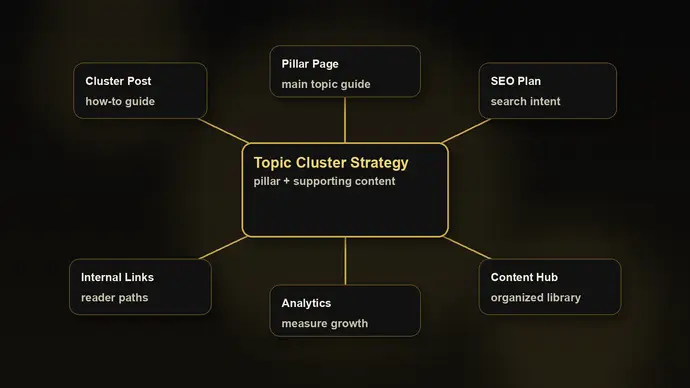
A topic cluster strategy is one of the cleanest ways to turn a messy blog into an organized SEO asset. Instead of publishing one-off posts whenever an idea sounds good, you group related articles around a central pillar page, connect them with intentional internal links, and make it easier for readers and search engines to understand what your site is actually about.
That matters more in 2026 because thin, isolated content has a harder time competing. Google says its ranking systems are designed to surface helpful, reliable, people-first information. A topic cluster does not magically rank content by itself, but it gives your best ideas structure. It helps you cover a subject with depth, avoid duplicate posts, and move readers from basic questions to deeper buying or decision-making pages.
Think of it like building a library section instead of tossing books onto random shelves. The pillar page is the main shelf label. The cluster posts are the specific books. Internal links are the aisle signs that help people find the next useful thing.
What Is a Topic Cluster Strategy?
A topic cluster strategy is an SEO content structure built around three parts:
- A pillar page: a broad guide that introduces the main topic and links to deeper resources.
- Cluster pages: focused articles that answer specific questions inside that topic.
- Internal links: clear connections between the pillar and the supporting pages.
For example, a small business might create a pillar page about email marketing. Supporting cluster posts could cover welcome email sequences, subject lines, segmentation, re-engagement campaigns, deliverability, and newsletter ideas. Each article answers a focused question. Together, they make the site more useful than a single general post ever could.
This structure also helps with planning. Instead of asking, “What should I post this week?” you ask, “What topic do I need to own, and what questions are missing from that section?” That shift is small, but it changes the quality of your content calendar fast.
Why a Topic Cluster Strategy Works for SEO in 2026
Search results are crowded. AI summaries, ads, local packs, videos, forums, and large publishers all compete for attention. Backlinko’s 2026 SEO statistics report notes that the first organic result has a much higher click-through rate than lower positions, with the top result often earning close to 40% of clicks. The lesson is simple: ranking on page one is not enough if your content does not deserve a top position.
A topic cluster strategy helps because it improves three things search engines already care about: relevance, crawl paths, and user usefulness.
1. Relevance gets easier to prove
One article on a subject can look like a guess. Ten useful articles connected around the same subject look like a real resource. If your site has a pillar page on content marketing plus focused articles on content calendars, content pillars, repurposing, case studies, and distribution, the relationship between those pages becomes clear.
Search engines do not need you to repeat a keyword 30 times. They need enough signals to understand the subject, the subtopics, and how each page helps the reader. Topic clusters create those signals naturally.
2. Internal links stop being random
Most internal linking fails because it is treated as an afterthought. Someone writes a post, remembers they need links, then drops in two unrelated links near the end. That is weak.
With clusters, internal links have a job. A beginner post can link to a deeper guide. A comparison post can link back to the main pillar. Related cluster posts can link to each other when the next step is obvious. Search Engine Land’s topic cluster guidance also recommends connecting related supporting articles to each other, not only linking every page back to the hub.
If you are just getting your SEO base in place, start with a practical foundation like keyword research for small business. Then use those topics to build clusters instead of disconnected posts.
3. Readers get a better path
SEO is not only about getting the click. The page has to help someone do the next thing. A good topic cluster gives readers a path from awareness to action.
Someone searching “what is a topic cluster” may not be ready to hire help today. But after reading the basics, they may want a content calendar, a keyword map, or a way to choose content pillars. If those next steps are linked clearly, the reader stays with you instead of going back to search.
How to Build a Topic Cluster Strategy Step by Step
You do not need a giant SEO team to build this. You need a clear topic, a simple map, and the discipline to connect pages as you publish.
Step 1: Pick one topic your business should be known for
Start with a topic that connects to your offers and your audience’s real questions. Good cluster topics are broad enough to support many articles, but not so broad that they become useless.
Weak topic: marketing.
Better topic: email marketing for service businesses.
Strong cluster topics usually pass this test:
- Your audience searches for it.
- You can write at least 8 to 15 useful supporting articles about it.
- It connects to a service, product, or conversion path.
- You have enough experience to say something useful, not just summarize search results.
If the topic is too wide, narrow it. If it is too narrow, combine it with a related idea.
Step 2: Choose the pillar page
The pillar page is the main guide for the cluster. It should cover the topic broadly, explain the major sections, and link to deeper resources. It does not need to answer every question in detail. That is what the cluster pages are for.
A pillar page for “social media strategy” might include sections on audience research, content pillars, posting schedules, platform selection, analytics, paid promotion, and community management. Each section can link to a more detailed article.
Do not make the pillar page a dumping ground. Keep it clean. The goal is to orient the reader and help them choose where to go next.
Step 3: Map the cluster pages
Once the pillar is clear, list supporting articles. Each one should target a specific question or search intent. You can use keyword tools, Google autocomplete, customer questions, sales calls, support emails, and competitor gaps.
For a “content strategy” cluster, supporting articles might include:
- How to choose content pillars
- How to build a content calendar
- How to repurpose content for social media
- How to write a case study
- Content distribution channels
- Content audit template
One useful existing resource is this guide on how to choose content pillars for social media, since content pillars often become the bridge between SEO planning and social media planning.
Step 4: Assign search intent to every page
Every page in the cluster needs a job. If two articles have the same job, combine them or change the angle.
Use simple labels:
- Definition: explains what something is.
- How-to: teaches a process.
- Template: gives a tool or framework.
- Comparison: helps the reader choose between options.
- Examples: shows what good execution looks like.
This keeps the cluster from cannibalizing itself. Cannibalization happens when multiple pages compete for the same search intent. It confuses search engines and usually weakens all of the pages involved.
Step 5: Build the internal linking rules before publishing
Internal links should be planned, not sprinkled in later. A simple structure works well:
- The pillar page links to every major cluster page.
- Every cluster page links back to the pillar page.
- Cluster pages link to related cluster pages when the next step is natural.
- High-intent pages link to relevant service or contact pages where appropriate.
Use descriptive anchor text. “Content calendar guide” is better than “click here.” “Email segmentation strategy” is better than “read more.” Clear anchor text helps readers and gives search engines more context.
Topic Cluster Strategy Example for a Small Business
Let’s say a consulting business wants to rank for searches around customer retention. A weak blog plan might include random posts like “5 marketing tips,” “Why customers matter,” and “How to grow this year.” Those posts may be fine individually, but they do not build a strong subject area.
A better topic cluster could look like this:
- Pillar page: Customer retention strategies for small businesses
- Cluster page: How to calculate customer lifetime value
- Cluster page: Customer journey mapping
- Cluster page: Re-engagement email examples
- Cluster page: Email segmentation strategy
- Cluster page: How to improve email deliverability
Now the content has direction. Someone can enter through a tactical article, move to the main guide, then continue into another useful page. The business also starts building authority around a subject tied directly to revenue.
Common Topic Cluster Strategy Mistakes
The structure is simple, but the execution can get messy. Watch for these mistakes.
Publishing cluster pages without a pillar
If you publish ten supporting posts but never create the central guide, the cluster feels incomplete. You can still rank individual articles, but the site architecture is weaker.
Making every article target the same keyword
This is a common SEO mistake. The focus keyword for the pillar should not be copied across every cluster page. Each supporting article needs its own target and purpose.
Writing thin supporting posts
A cluster is not an excuse to publish shallow content. Each page should solve a real question. If an article only exists to hit a keyword, readers will feel it.
Ignoring old posts
You may already have half a cluster sitting on your blog. Audit existing posts before writing new ones. Update strong articles, merge overlapping ones, and add links where they make sense.
How to Measure Whether Your Topic Cluster Strategy Is Working
Give the cluster time. SEO does not move overnight. Still, you should track whether the structure is helping.
Watch these signals:
- Organic clicks and impressions for the pillar page
- Organic clicks and impressions for cluster pages
- Average position changes for target keywords
- Internal link clicks when available
- Engagement metrics such as time on page and conversions
- New keywords the cluster starts ranking for
Google Search Console is usually enough to start. Look at the whole cluster, not just one page. A supporting article may not drive many conversions by itself, but it may help readers reach a higher-intent page.
How to Put Your Topic Cluster Strategy Into Action
A topic cluster strategy is not complicated. It is disciplined. Pick the topic, create the pillar, map the supporting articles, link them clearly, and keep improving the cluster over time.
The best part is that this approach makes your content easier to plan and easier to use. Readers get a path. Search engines get structure. Your business gets a blog that compounds instead of a pile of disconnected posts.
Start with one cluster. Build it properly. Revisit it every quarter, add missing articles, and tighten the links between pages as your content library grows.