
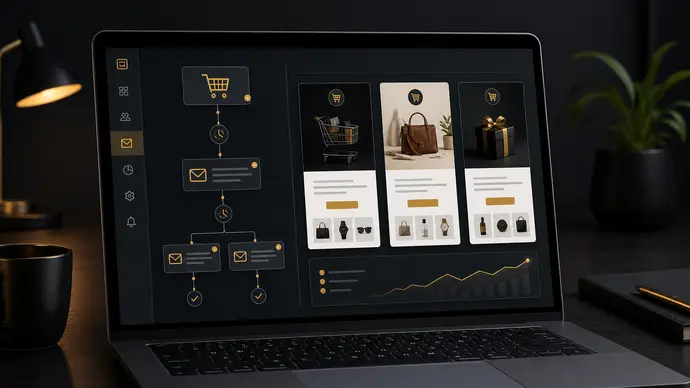
Abandoned cart email templates give ecommerce teams a faster way to recover revenue that is already close to purchase. The shopper has picked a product, shown intent, and left before payment. A good cart recovery sequence does not beg, over-discount, or sound automated. It reminds the customer what they wanted, removes friction, and gives them a clear reason to come back.
Cart abandonment is normal. Baymard Institute's cart abandonment benchmark puts the average abandonment rate at 70.22%, based on 50 ecommerce studies. That means most stores do not need more traffic before they fix recovery. They need a better follow-up system.
Email is still one of the best tools for that job because it lets you show the exact product, answer objections, add proof, and time each message around buying intent. Klaviyo's public abandoned cart benchmark data also shows why the flow deserves attention: top-performing abandoned cart flows can drive far more revenue per recipient than most automated email flows. The gap between an average cart email and a strong one is usually not fancy design. It is timing, clarity, and message fit.
Why abandoned cart email templates work best as a sequence
One reminder can help. A short sequence usually works better. The reason is simple: customers abandon carts for different reasons. Some get distracted. Some compare prices. Some pause because shipping, trust, sizing, payment options, or timing feels wrong. One email cannot handle every reason without becoming bloated.
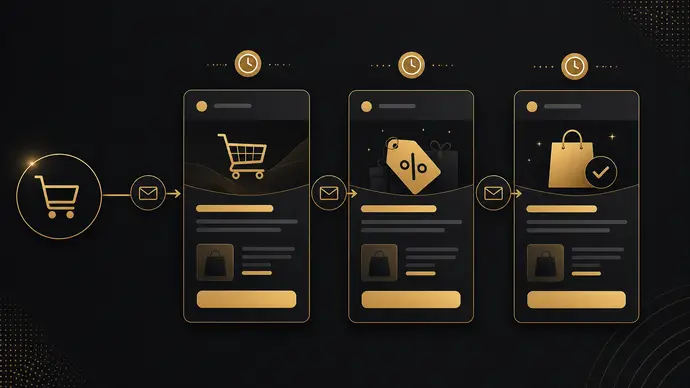
A better approach is to give each email a single job:
- Email 1 reminds the shopper what they left behind.
- Email 2 answers the most likely objection.
- Email 3 adds urgency or a measured incentive.
Omnisend and Shopify both point to a common baseline: send the first email about one hour after abandonment, then follow up around 24 hours and 72 hours if the cart is still open. That timing is not a law. High-consideration products may need a longer window. Low-cost impulse purchases may need a faster nudge. Use the sequence below as a starting point, then test timing against placed orders, not open rates alone.
Abandoned cart email templates for the first reminder
The first email should feel useful, not pushy. The shopper remembers the product. Your job is to make it easy to return.
Subject line options:
- You left something in your cart
- Still thinking it over?
- Your cart is saved
- Quick reminder: your items are waiting
Template:
Hi [First Name],
You left [Product Name] in your cart, so we saved it for you.
If you are ready, you can pick up right where you left off here:
Questions about sizing, shipping, or checkout? Reply to this email and we will help.
[Store Name]
Why it works: It is direct. It does not pretend the customer made a mistake. It gives them one obvious action. For many stores, this should be the cleanest email in the flow.
Add a product image, price, variant, and cart button if your email platform supports dynamic cart blocks. Keep the body short. The product already did part of the selling.
Abandoned cart email templates for objection handling
The second email should answer the question that likely stopped the purchase. This is where segmentation helps. If you sell apparel, sizing and returns matter. If you sell supplements, ingredients and trust matter. If you sell higher-ticket products, reviews, guarantees, shipping speed, and payment options may matter more.
For a broader email strategy, pair this flow with smart list building and segmentation. Aslan Agency has guides on email segmentation strategy and email marketing best practices that can help you make each cart email more relevant.
Subject line options:
- Need help choosing?
- A few details before you decide
- Still interested in [Product Name]?
- What shoppers ask before buying
Template:
Hi [First Name],
Still looking at [Product Name]? Here are a few things customers usually want to know before they buy:
- Shipping: [Short shipping detail]
- Returns: [Short return detail]
- Support: [Short support detail]
You can review your cart here:
If anything is unclear, reply with your question. A real person will help.
Why it works: It respects hesitation instead of fighting it. A lot of abandoned carts are not a hard no. They are a paused decision.
★★★★★5-star client feedback
Turn your abandoned Cart Email Templates That Recover Sales into a growth plan.
Tell us what you are trying to achieve with email marketing. We will turn the ideas in this guide into a practical next-step plan.
Abandoned cart email templates with social proof
Social proof works best when it is specific. Do not paste generic praise under a cart button and call it a day. Use a short review that speaks to the same concern the shopper may have.
If price is the issue, show a review about value. If fit is the issue, show a review about sizing accuracy. If trust is the issue, show review count, return policy, secure checkout, press mentions if real, or user-generated content from actual customers.
Subject line options:
- Why customers come back for [Product Name]
- See why shoppers like this
- A quick note from a customer
- Still deciding? This may help
Template:
Hi [First Name],
You were looking at [Product Name], so we wanted to share what another customer said:
"[Short review that addresses a real objection.]"
Your cart is still saved here:
[Store Name]
Why it works: The email does not need a long argument. A relevant proof point can lower risk faster than another paragraph of product copy.
Abandoned cart email templates with an incentive
Discounts can recover carts, but they can also train customers to wait. Use them carefully. If your margins are tight, try free shipping, a small first-order perk, loyalty points, a bundle bonus, or a deadline before you jump to 15% off.
The safest place for an incentive is usually the final email. By then, the shopper has ignored the simple reminder and the objection-handling message. You are less likely to discount an order that would have happened anyway.
Subject line options:
- Last call for your cart
- Your cart expires soon
- A little help finishing your order
- Still want it? Here is [Offer]
Template:
Hi [First Name],
Your cart is still saved, but we cannot hold it forever.
Use code [Code] for [Offer] before [Deadline].
If now is not the right time, no pressure. We just wanted to make sure you had the option.
Why it works: It creates a reason to act without sounding desperate. The deadline should be real. Fake urgency burns trust fast.
How to personalize abandoned cart email templates
Personalization should make the email more useful, not just insert a first name. Start with the cart data you already have.
- Product name: Mention the exact item in the subject line or first sentence.
- Product image: Show what the shopper left behind.
- Category: Send different proof points for skincare, apparel, home goods, software, or services.
- Cart value: Use different incentives for low, medium, and high cart values.
- Customer type: Treat first-time shoppers differently from repeat customers.
- Inventory: Mention low stock only when inventory is actually low.
A repeat customer may not need a long trust-building email. They may need a reminder and a faster path back to checkout. A first-time shopper may need reviews, return policy details, payment security, or shipping clarity.
This is also where your wider content and email system matters. If a customer joined from a guide, quiz, or social campaign, their abandoned cart email should match the promise that brought them in. That is how automated emails start feeling less automated.
What every abandoned cart email should include
Templates are useful, but the basics decide whether the flow makes money. Before you test clever subject lines, make sure every abandoned cart email has these pieces:
- A clear cart button: Do not make shoppers hunt for the next step.
- Dynamic cart content: Product image, name, price, variant, and cart link.
- One main CTA: Secondary links can distract from checkout.
- Mobile-friendly design: Many shoppers abandon carts on mobile and return from mobile.
- Plain language: Say what happened and what to do next.
- Support path: Let shoppers reply or get help quickly.
- Compliance basics: Include unsubscribe links and send only to contacts you are allowed to email.
Keep the email scannable. A shopper who is ready to buy should be able to click within a few seconds. A shopper who is unsure should find one useful reason to continue.
Common mistakes that weaken abandoned cart email templates
The most common mistake is over-writing. Cart emails are not newsletters. They are recovery messages tied to a specific action. If the email starts with a long intro about your company, cut it.
Other mistakes include sending the first email too late, showing the wrong product, stacking too many CTAs, using fake scarcity, hiding shipping costs until checkout, and offering a discount in the first message before testing whether a reminder would have worked.
Watch deliverability too. If your recovery emails land in spam, the template will not matter. Keep your sender reputation clean, remove inactive contacts, authenticate your domain, and avoid spammy subject lines. If email performance is inconsistent, review Aslan Agency's guide on how to improve email deliverability.
How to measure abandoned cart email performance
Open rate tells you whether the subject line earned attention. Click rate tells you whether the email created action. Placed order rate and revenue per recipient tell you whether the flow made money.
Track these numbers by email in the sequence, not only across the full flow:
- Open rate
- Click rate
- Placed order rate
- Revenue per recipient
- Unsubscribe rate
- Spam complaint rate
- Time from abandonment to purchase
If email 1 gets clicks but few orders, checkout friction may be the issue. If email 2 gets low clicks, the objection message may be too broad. If the final incentive email drives most purchases, test whether the offer is too early, too rich, or needed only for certain cart values.
The goal is not to squeeze every shopper. The goal is to recover purchases from people who still want the product and need a better path back.
Final abandoned cart email templates checklist
Before you launch, run the flow through this checklist:
- The first email sends around one hour after abandonment.
- The sequence has two to three emails, not one overloaded message.
- Each email has one job.
- The focus product appears clearly.
- The cart button works on desktop and mobile.
- The second email answers a real buying objection.
- The final email uses urgency or an incentive only when appropriate.
- Discounts are segmented by cart value or customer type where possible.
- The flow excludes people who already purchased.
- The results are measured by revenue and placed orders, not only opens.
Start with the templates above, then adjust them based on what your customers actually do. A strong cart recovery flow is rarely complicated. It is timely, clear, and useful at the exact moment a shopper is deciding whether to come back.
★★★★★5-star client feedback
Ready to put your abandoned Cart Email Templates That Recover Sales into action?
Bring us your goals, current setup, and biggest constraint. We will map the clearest way to apply email marketing to your business.