
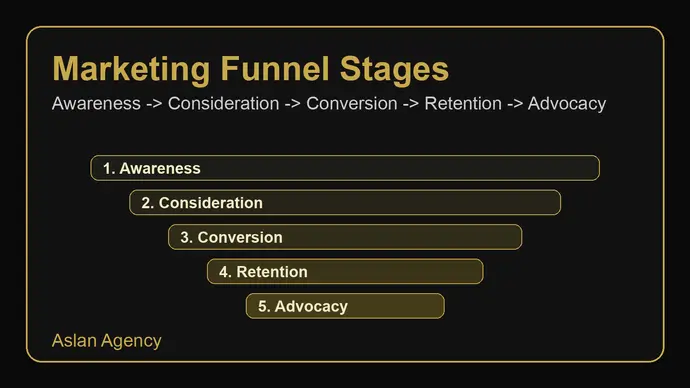
Marketing funnel stages are the steps a person moves through before becoming a customer, then a repeat buyer or referrer. For small businesses, the funnel is not just a diagram in a slide deck. It is a practical way to decide what to publish, what to measure, and where prospects are getting stuck.
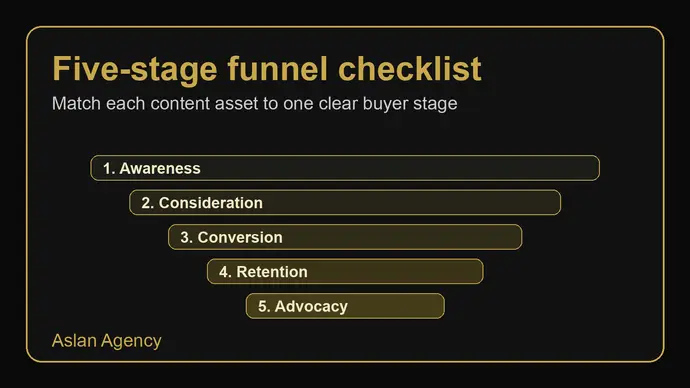
The classic funnel usually starts with awareness, moves into consideration, then conversion, retention, and advocacy. That model still works in 2026, but it needs one adjustment: people rarely move in a clean straight line. A potential customer might see a social post, search Google two weeks later, read reviews, compare pricing, ignore three emails, then finally book a call after a friend mentions your name. The stages help you make sense of that messy path without pretending it is simple.
Google's recent customer journey research makes the same point: the old linear funnel does not tell the full story anymore because buyers interact with multiple touchpoints across awareness, consideration, and purchase. HubSpot's recent marketing data also shows why content variety matters, with short-form video, long-form video, and blog posts all ranking among commonly used marketing formats. The takeaway is straightforward. If your funnel depends on one channel or one piece of content, it is probably too thin.
What are the marketing funnel stages?
The main marketing funnel stages are awareness, consideration, conversion, retention, and advocacy. Some teams use different names, like top of funnel, middle of funnel, and bottom of funnel. The labels matter less than the job each stage has to do.
Awareness is where people first realize you exist or first notice a problem you can help solve. At this stage, they may not be ready to buy. They may not even know what to search for yet. Good awareness content is useful before it is persuasive. Examples include educational blog posts, short videos, social posts, comparison guides, checklists, and beginner-friendly explainers.
Consideration is where prospects understand the problem and start comparing options. They are asking better questions now. They want proof, examples, pricing context, process details, and a clearer reason to trust you. This is where case studies, service pages, product comparisons, FAQs, webinars, email sequences, and review-driven content matter.
Conversion is where the prospect takes the action you want: booking a call, buying, requesting a quote, joining a list, signing up for a trial, or submitting a form. This stage needs clear pages, strong offers, simple next steps, trust signals, and fast follow-up. If conversion is weak, the issue is often not traffic. It is usually friction.
Retention starts after the first sale. This stage is easy to ignore because most marketing teams obsess over new leads, but retention is where profit often improves. Onboarding emails, customer education, check-ins, loyalty offers, community content, and helpful updates all belong here.
Advocacy is where satisfied customers refer others, leave reviews, share content, create testimonials, or talk about your business in public. You cannot fake this stage. You can only make it easier by asking at the right time and giving people a simple way to help.
Why marketing funnel stages matter for small businesses
Most small businesses do not have a traffic problem first. They have a funnel problem. They post often, run ads, send emails, or publish content, but every activity sits in its own little box. Nobody has mapped what each piece is supposed to do.
That creates two common issues. First, the business creates too much awareness content and not enough consideration or conversion content. People discover the business, but they never get enough detail to take the next step. Second, the business asks for the sale too early. Every post becomes a pitch, so prospects who are still learning tune out.
A clear funnel fixes both problems. It gives every marketing asset a job. A TikTok video might introduce a pain point. A blog post might explain the options. A case study might prove the method works. A landing page might turn interest into a booked call. A follow-up email might rescue someone who was close but hesitated.
If you have already mapped your customer path, this becomes easier. Our guide to customer journey mapping for small business shows how to connect customer questions, objections, and touchpoints across the buying process.
Marketing funnel stages and the content that fits each one
The fastest way to improve a funnel is to match content to intent. A person who just discovered a problem needs different information than someone choosing between two providers. Treating them the same wastes attention.
For awareness, focus on reach and clarity. The prospect is asking broad questions like "Why is my social media not growing?" or "How do I get more leads from my website?" Useful content at this stage includes how-to posts, beginner guides, myth-busting posts, educational reels, search-friendly blog articles, and simple checklists. The tone should be helpful, not pushy.
For consideration, focus on trust and comparison. The prospect is asking, "What should I choose?" "How much work is this?" "What results are realistic?" Good content includes comparison pages, service explainers, pricing context, case studies, email nurture sequences, demos, and before-and-after examples. This is also where social proof matters. A testimonial is stronger when it speaks to a specific fear or desired result.
For conversion, focus on action. The prospect is asking, "What happens if I say yes?" Your page should answer that quickly. Make the offer clear, explain the next step, remove unnecessary form fields, show proof near the call to action, and reduce anything that makes the decision feel risky.
For retention, focus on confidence after the sale. Customers should feel like they made the right choice. Welcome emails, onboarding guides, usage tips, monthly updates, customer-only resources, and review requests all help here. Retention content is also a good place to reduce support load because it answers questions before they become problems.
For advocacy, focus on timing. Ask for a review after a win, not randomly. Ask for a referral when the customer has just experienced a clear result. Make sharing simple. Give them a short testimonial prompt, a direct review link, or a referral offer that is easy to explain.
How to audit your marketing funnel stages
A funnel audit does not need to be complicated. Start with a list of everything you already use to attract and convert customers: website pages, blog posts, emails, ads, social posts, lead magnets, sales calls, review requests, and onboarding messages. Then assign each item to one funnel stage.
You will usually see the gaps quickly. A business may have dozens of awareness posts but only one weak service page. Another may have a strong sales page but no nurture emails. Another may get plenty of leads but lose them because nobody follows up fast enough.
After you map the assets, check the numbers attached to each stage. Awareness metrics include impressions, reach, search clicks, video views, and new visitors. Consideration metrics include returning visitors, time on page, email clicks, content downloads, comparison page visits, and replies. Conversion metrics include form fills, booked calls, purchases, quote requests, and close rate. Retention metrics include repeat purchase rate, churn, customer lifetime value, and support volume. Advocacy metrics include reviews, referrals, testimonials, shares, and user-created mentions.
Do not measure everything just because you can. Pick a few numbers that reveal movement. For example, if awareness is strong but booked calls are low, look at service page conversion rate, call-to-action placement, form length, and proof. If leads are strong but sales are weak, review follow-up speed, offer clarity, pricing expectations, and objections that come up on calls.
Customer lifetime value can also change how you judge the funnel. If repeat customers are worth far more than first-time buyers, retention deserves more attention. Our guide on how to calculate customer lifetime value can help you decide how much you can afford to spend to acquire a customer.
Marketing funnel stages example for a service business
Here is a simple funnel for a local service business or consultant.
At the awareness stage, the business publishes search-friendly blog posts that answer common buyer questions, short videos that explain mistakes to avoid, and social posts that show simple wins. The goal is not to sell immediately. The goal is to become familiar and useful.
At the consideration stage, the business sends visitors to a service page with examples, FAQs, pricing context, and proof. It also uses a short email sequence for people who downloaded a checklist or booked a discovery call but did not buy yet. The content answers the questions prospects are already thinking but may be too polite to ask.
At the conversion stage, the call booking page is clean. It explains who the service is for, what happens after booking, how long the call takes, and what the prospect should bring. There is no clutter around the form. The page has one main action.
At the retention stage, new customers receive a welcome email, clear next steps, a timeline, and helpful reminders. After the project or first month, the business checks in, shares results, and suggests the next useful action.
At the advocacy stage, happy customers get a direct review link and a short prompt. The business asks specific questions, such as "What changed after working together?" or "What would you tell someone considering this service?" Specific prompts lead to better testimonials than vague requests.
Common mistakes with marketing funnel stages
The first mistake is treating the funnel like a one-time setup. A funnel is never finished. Search behavior changes, platforms shift, customer objections change, and offers mature. Review the funnel at least quarterly so weak spots do not sit unnoticed for a year.
The second mistake is sending every visitor to the same page. Someone reading an educational post may need a related guide before a sales call. Someone viewing pricing may need proof and a direct booking option. Intent should decide the next step.
The third mistake is measuring the wrong stage. If your awareness content is new, judging it only by sales may cause you to quit too early. If your conversion page has traffic but no leads, blaming the algorithm is probably wrong. Match the metric to the stage before making decisions.
The fourth mistake is forgetting what happens after the sale. Retention and advocacy are part of the funnel because they affect profit. A customer who buys twice, leaves a review, and sends a referral is worth more than a one-time buyer from an expensive ad.
How to improve each marketing funnel stage
Improve awareness by answering real questions. Pull ideas from sales calls, support emails, search queries, comments, and reviews. If prospects use plain language, use plain language in your content. Clever wording is less useful than being found and understood.
Improve consideration by showing proof earlier. Add examples, screenshots, testimonials, process explanations, objections, and realistic outcomes. People do not need more hype at this stage. They need confidence.
Improve conversion by removing friction. Shorten forms, clarify the offer, simplify the page, make the next step obvious, and follow up quickly. If people are close to buying, tiny points of confusion can cost real money.
Improve retention by creating a better first 30 days. Most customer doubt appears early. A strong onboarding sequence, clear expectations, and proactive updates can reduce refunds, churn, and support questions.
Improve advocacy by asking for help when the result is fresh. The best time to ask for a review or referral is right after a customer has seen value. Make the ask specific, easy, and low pressure.
The bottom line on marketing funnel stages
Marketing funnel stages help you see where attention turns into trust, where trust turns into action, and where customers become repeat buyers or advocates. The model is simple, but it works because it forces a better question: what does this person need next?
If your marketing feels busy but inconsistent, map your current assets to awareness, consideration, conversion, retention, and advocacy. The missing stage is usually the next place to work. Fix that gap before adding another platform, another campaign, or another batch of random posts.