

A voice of customer template turns scattered feedback into language your team can actually use. Instead of collecting quotes in one document, survey answers in another, and support notes somewhere else, the template below gives you a repeatable system for capturing what customers say, sorting it by meaning, and applying it to messaging, content, sales, and product decisions.
The most useful voice of customer work is not a hunt for compliments. It is a disciplined way to understand the situation customers were in, what frustrated them, what they tried, what changed their mind, and what outcome they wanted. The exact words matter because customers often describe the problem differently than an internal team does.
This guide includes a copy-ready template, interview questions, survey prompts, an analysis method, and examples of how to convert raw comments into clearer marketing.
What a Voice of Customer Template Should Capture
A strong template preserves the original customer quote while adding enough context to make it useful. If you only save a sentence such as "It saved me time," you lose the details that make the statement believable. How much time? Compared with what? What was taking so long before? What did the customer do with the time they recovered?
Your collection sheet should include these fields:
| Field | What to Record | Why It Matters |
|---|---|---|
| Source | Interview, survey, support ticket, review, call, or social comment | Helps you judge context and reliability |
| Customer segment | Role, company type, use case, or purchase stage | Prevents mixing feedback from unrelated audiences |
| Exact quote | The customer's words without rewriting | Preserves natural language for messaging |
| Situation | What was happening before the customer looked for help | Explains the trigger behind the search |
| Pain point | The practical or emotional problem | Shows what needs to change |
| Desired outcome | The result the customer wants | Clarifies what success means |
| Objection | Concern about price, effort, trust, timing, or fit | Improves sales and conversion content |
| Alternative tried | Previous tool, process, vendor, or workaround | Reveals your real competition |
| Theme | A short label applied during analysis | Makes repeated patterns easier to count |
| Marketing use | Headline, landing page, email, ad, FAQ, or sales script | Connects research to action |
Keep the exact quote separate from your interpretation. The quote is evidence. The theme is your analysis. Combining them too early makes it easy to replace the customer's meaning with internal assumptions.
Copy-Ready Voice of Customer Template
Use one row per meaningful quote. A single interview answer may create several rows if it contains a trigger, a pain point, an objection, and a desired result.
| Date | Segment | Source | Exact Quote | Situation | Pain | Outcome | Objection | Theme | Use |
|---|---|---|---|---|---|---|---|---|---|
| [Date] | [Who said it] | [Interview or survey] | [Verbatim words] | [What triggered the need] | [Problem] | [Wanted result] | [Concern] | [Theme label] | [Page or campaign] |
| [Date] | [Who said it] | [Review or support] | [Verbatim words] | [Context] | [Problem] | [Wanted result] | [Concern] | [Theme label] | [Page or campaign] |
For a simple setup, build this in a spreadsheet and add filters for customer segment, source, theme, and purchase stage. Teams with larger feedback volumes can use a research repository, but the method stays the same. The tool matters less than consistent tagging and regular review.
Spreadsheet header row: Copy the line below and paste it into the first row of a blank spreadsheet. Most spreadsheet tools will split the comma-separated fields into columns.
Date,Customer Segment,Source,Exact Quote,Situation,Pain Point,Desired Outcome,Objection,Alternative Tried,Theme,Purchase Stage,Marketing Use

How to Collect Better Voice of Customer Quotes
Use several sources so one channel does not distort the picture. Interviews are useful for depth. Surveys help you hear from more people. Support conversations reveal recurring friction. Reviews contain unprompted language about expectations and results. Sales calls expose questions and objections that may never appear in a satisfaction survey.
Customer interviews
Interview recent customers, lost prospects, long-term customers, and people who stopped using the offer. Ask about real events rather than hypothetical preferences. "What happened the last time you tried to solve this?" usually produces better evidence than "Would you use a feature that solves this?"
Useful interview questions include:
- What was happening when you first realized you needed a different solution?
- What had you tried before, and why was it not working?
- What part of the problem was most frustrating or expensive?
- What nearly stopped you from moving forward?
- What information helped you feel confident in the decision?
- What changed after you started using the solution?
- How would you explain the value to someone in a similar situation?
Follow up when an answer is vague. If someone says a process was "easier," ask what became easier. If they say the result was "better," ask what they noticed, measured, or stopped worrying about.
Surveys
Keep surveys focused. Long forms often produce rushed answers, while a few well-timed open questions can surface useful language. The GOV.UK Service Manual recommends starting research with clear learning questions and prioritizing broad questions that begin with words such as who, what, when, where, and why. That principle matters here because narrow or leading questions can fill your template with confirmation rather than insight.
Try these survey prompts:
- What was the main reason you started looking for a solution?
- What was the biggest concern you had before choosing?
- What is the most useful result you have received?
- What would you improve if you could change one thing?
- What words would you use to describe the experience to a colleague?
Support, reviews, and sales conversations
These sources are already being created, so they are often the fastest place to start. Pull recurring questions from support tickets, objections from sales notes, and outcome language from reviews. Remove personal information before sharing excerpts internally. Also record whether the comment came before or after purchase because the same phrase can mean something different at each stage.
How to Analyze a Voice of Customer Template
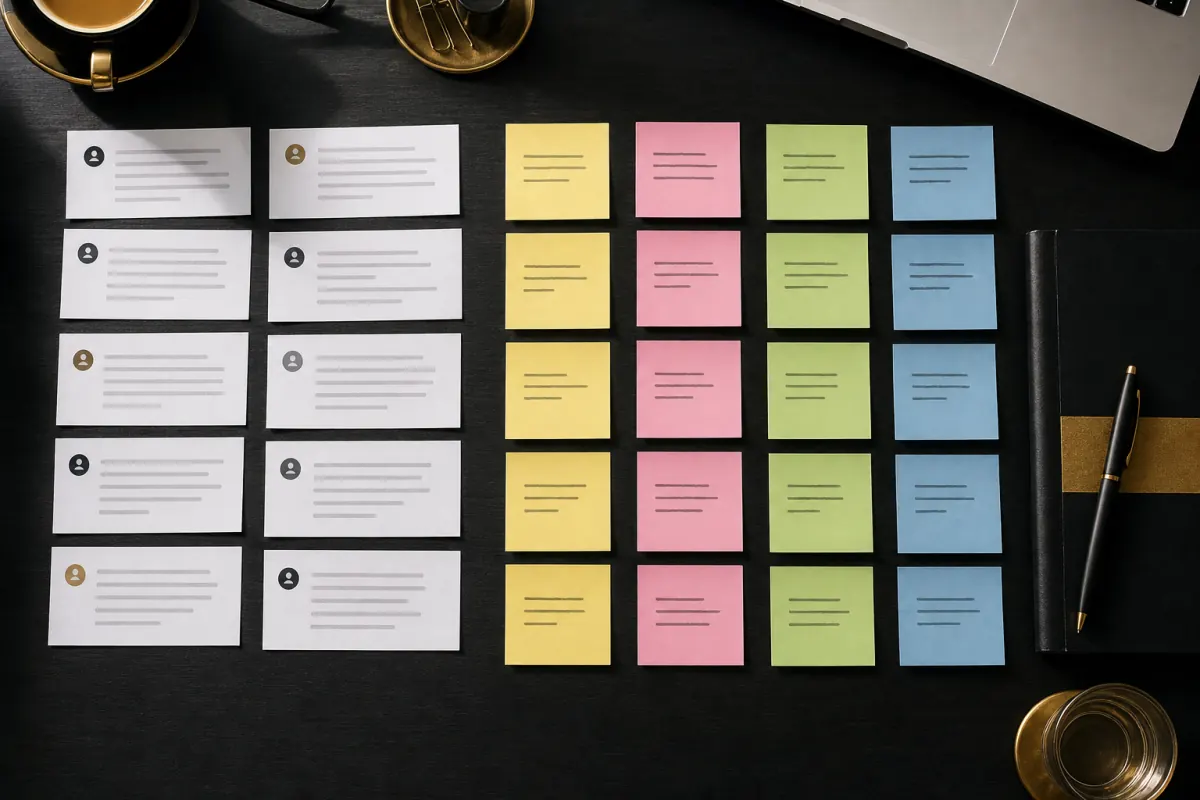
Collection is only the first half of the job. The template becomes valuable when you review comments together and look for repeated situations, pains, outcomes, objections, and phrases.
Step 1: Clean the data without polishing it
Remove names and private details. Correct obvious transcription errors if needed, but do not rewrite the customer's grammar or vocabulary. A phrase that sounds unusual to your team may be exactly how the market talks about the problem.
Step 2: Tag each quote
Start with a small set of labels: trigger, pain point, desired outcome, objection, alternative, decision factor, and result. Add topic labels only when repeated evidence supports them. Too many labels create a filing project instead of an insight system.
Step 3: Separate frequency from importance
A common complaint deserves attention, but frequency is not the only signal. A less common objection may block a high-value purchase. A phrase used by several best-fit customers may matter more than a phrase used by many poor-fit leads. Review patterns by segment, customer value, purchase stage, and source.
Step 4: Create a message map
Translate the strongest themes into a practical map:
- Problem: What customers say is going wrong.
- Consequence: What the problem costs in time, money, confidence, or opportunity.
- Desired result: What customers want instead.
- Proof needed: What would make the claim believable.
- Objection: What could prevent action.
- Response: The evidence, explanation, or guarantee that addresses the concern.
This message map can feed a content strategy template, landing page briefs, sales enablement, email sequences, and ad concepts.
Voice of Customer Template Example
Imagine a service business hears the following comment during an interview:
"We had plenty of content ideas, but everything lived in different documents. By the time we agreed on what to publish, the moment had passed."
The template might break it down like this:
- Situation: The team had ideas but no shared planning process.
- Pain point: Slow decisions and scattered documents.
- Consequence: Missed timely publishing opportunities.
- Desired outcome: Faster agreement and one source of truth.
- Customer language: "Everything lived in different documents" and "the moment had passed."
- Marketing use: Landing page problem section, email subject line, or sales discovery prompt.
A weak headline based on internal language might say, "Centralize Your Content Operations." A customer-led version could say, "Stop Losing Timely Content Ideas Across Scattered Documents." The second version is more concrete because it reflects the actual situation and consequence.
Voice of customer research also pairs well with customer journey mapping. The journey shows when questions appear. The template shows how customers describe those questions.
Common Mistakes to Avoid
Collecting only positive feedback
Testimonials can support proof, but they do not explain every purchase barrier. Include complaints, cancellations, lost deals, and confused support requests. They often reveal the clearest opportunities.
Paraphrasing too soon
Teams often turn a specific comment into a broad label such as "needs convenience." Keep the quote. The phrase "I had to ask three people where the file was" is more useful than the category "convenience."
Treating every customer as one audience
A first-time buyer, a power user, and a former customer may want different outcomes. Segment the feedback before counting themes. Otherwise, the most vocal group can overpower the most relevant one.
Publishing claims without proof
Customer language can inspire a claim, but it does not automatically prove that claim for everyone. Pair strong wording with case studies, measured results, demonstrations, process details, or clear limitations.
Researching once and never updating
Review the template monthly or quarterly, depending on feedback volume. New competitors, pricing changes, product updates, and market conditions can change the questions customers ask.
A Simple Monthly Workflow
- Export new survey responses, reviews, support notes, and sales objections.
- Add useful verbatim quotes to the template.
- Tag each quote by segment, stage, theme, and source.
- Review repeated patterns with marketing, sales, service, and product owners.
- Select three to five insights that can change a real decision.
- Update messaging, content briefs, FAQs, sales scripts, or onboarding.
- Track whether the change improves response, conversion, retention, or support volume.
Medallia describes voice of customer work as collecting customer preferences and experiences, sharing that information inside the organization, and using it to improve products and services. The final step is the one teams skip most often. A large feedback database is not the goal. Better decisions are.
Start With One Specific Question
Do not begin by trying to understand everything customers think. Pick one decision. You might want to improve a landing page, learn why qualified prospects hesitate, find better email topics, or understand why customers cancel.
Then collect evidence from the people closest to that decision. Add their exact words to the voice of customer template, tag the patterns, and choose one change you can test. A focused research cycle completed this week will teach you more than a perfect system that never gets used.