
If you want to know how to calculate customer lifetime value, start with a simple question: how much profit does one customer create over the full time they buy from you? Once you know that number, marketing stops feeling like guesswork. You can decide how much to spend to win a customer, which offers deserve more attention, and which customer groups are actually worth chasing.
Customer lifetime value, often shortened to CLV or LTV, is the estimated value of a customer across the full relationship. For a retailer, that might mean repeat purchases over several years. For a consultant, it might mean the first project, future retainers, referrals, and upsells. For a subscription business, it might mean monthly revenue multiplied by how long the customer stays.
The math does not need to be complicated. The mistake most businesses make is waiting until they have perfect data. You do not need perfect data. You need a useful estimate, a clear formula, and a habit of updating the number as your business learns more.
How to calculate customer lifetime value with the basic formula
The simplest CLV formula is:
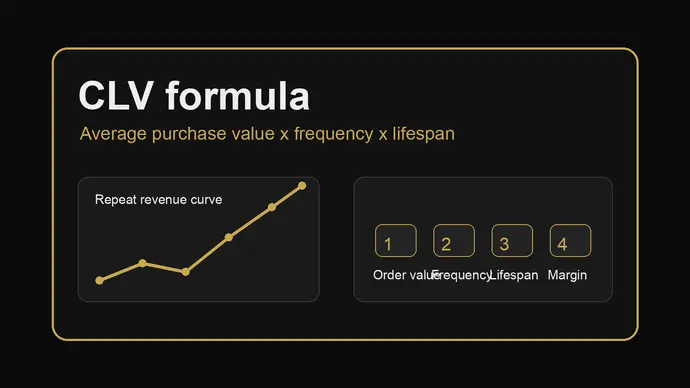
Customer lifetime value = average purchase value x purchase frequency x average customer lifespan
This version works well for businesses with repeat purchases, such as ecommerce stores, local services, coaching programs, restaurants, fitness studios, and many professional services. Salesforce, HubSpot, Shopify, Twilio, and Zoho all explain CLV using a similar structure: customer value starts with average order value and buying frequency, then expands across the expected length of the customer relationship.
Here is what each part means:
- Average purchase value: total revenue divided by total number of purchases during the period you are measuring.
- Purchase frequency: total purchases divided by total unique customers during that same period.
- Average customer lifespan: the average time a customer continues buying from you.
Say your business generated $120,000 from 2,000 purchases last year. Your average purchase value is $60. If those 2,000 purchases came from 800 customers, your purchase frequency is 2.5 purchases per customer per year. If the average customer stays active for 3 years, your CLV estimate is:
$60 x 2.5 x 3 = $450
That means the average customer is worth about $450 in revenue over the full relationship. If your gross margin is 60 percent, the gross profit value is $270. That second number is often more useful for marketing decisions because ad spend comes out of profit, not revenue.
How to calculate customer lifetime value using gross margin
Revenue-based CLV can make a business look healthier than it really is. If a customer spends $1,000 but your cost to deliver the product or service is $700, the customer did not create $1,000 of room for marketing. They created about $300 before overhead.
For that reason, use this formula when you want a cleaner marketing number:
Gross profit CLV = average purchase value x purchase frequency x average customer lifespan x gross margin
Using the earlier example, the customer produced $450 in lifetime revenue. With a 60 percent gross margin, the gross profit CLV is:
$450 x 0.60 = $270
Now the marketing decision is clearer. If it costs $90 to acquire a customer, the business earns roughly three dollars in gross profit value for every dollar spent on acquisition. A 3:1 lifetime value to acquisition cost ratio is a common healthy target, though the right number depends on cash flow, sales cycle length, fulfillment cost, and how quickly customers pay you back.
How to calculate customer lifetime value for subscriptions
Subscription businesses usually calculate CLV differently because revenue arrives in monthly or annual cycles. A practical subscription formula is:
Customer lifetime value = average revenue per account x gross margin percentage / churn rate
Twilio gives this style of formula for subscription businesses because churn has such a direct effect on value. If customers pay $100 per month, gross margin is 70 percent, and monthly churn is 5 percent, the estimate looks like this:
($100 x 0.70) / 0.05 = $1,400
That customer is worth about $1,400 in gross profit over the relationship. If churn drops from 5 percent to 4 percent, the same formula becomes:
($100 x 0.70) / 0.04 = $1,750
That one-point churn improvement adds $350 in lifetime value per customer. This is why retention matters so much. Bain research, often cited by Harvard Business Review, found that a 5 percent increase in customer retention can increase profits by 25 percent to 95 percent. The exact lift will vary by business, but the direction is hard to ignore: keeping good customers usually beats constantly replacing them.
Which numbers you need before you calculate CLV
You can calculate a starter CLV with five inputs. Pull them from your ecommerce platform, CRM, Stripe account, accounting software, or Google Analytics reports. If the numbers are messy, start with a 12-month window and clean it up over time.
- Total revenue: revenue from the customer group you are analyzing.
- Total purchases: number of orders, invoices, contracts, or paid transactions.
- Unique customers: the number of individual customers who bought during the period.
- Gross margin: revenue left after direct costs.
- Customer lifespan or churn: how long customers stay active, or how quickly they leave.
Do not combine wildly different customer types if they behave differently. A one-time buyer and a repeat referral customer should not be treated as the same person in your math. Segmenting the data makes CLV more useful. If you already use email segments, loyalty groups, sales source tracking, or audience personas, those segments are a good place to start.
If you need a cleaner view of the path people take before and after purchase, map it against your customer journey. That helps you see which touchpoints create repeat purchases and which ones create dead ends.
A simple customer lifetime value example
Imagine a service business with three customer groups:
- Group A spends $300 once and rarely returns.
- Group B spends $150 three times per year and stays for two years.
- Group C spends $500 once, then sends referrals worth another $700 on average.
If you only look at the first purchase, Group A looks better than Group B. But CLV tells a different story:
- Group A: $300 lifetime revenue.
- Group B: $150 x 3 x 2 = $900 lifetime revenue.
- Group C: $500 + $700 referral value = $1,200 lifetime value before margin.
This changes the marketing plan. You might spend less on campaigns that attract Group A and more on content, email, and social proof that bring in Groups B and C. You might also create a referral offer for Group C because those customers create value beyond their own invoices.
This is where CLV becomes practical. It does not just sit in a spreadsheet. It tells you which customers to attract, which offers to improve, which channels deserve budget, and which retention campaigns are worth building.
How CLV should shape your marketing budget
Once you know CLV, compare it to customer acquisition cost. The formula is simple:
LTV to CAC ratio = customer lifetime value / customer acquisition cost
If your gross profit CLV is $270 and your customer acquisition cost is $90, your ratio is 3:1. That is usually a solid starting point. If your ratio is 1:1, you are spending too much or keeping customers for too little time. If your ratio is 8:1, you may be underinvesting in growth, assuming you can handle more demand.
CLV also helps you judge marketing channels more fairly. Paid ads may look expensive on the first sale but profitable after repeat purchases. Organic social may look slow until you factor in lower acquisition costs and warmer referrals. Email may look boring until you see how much repeat revenue it creates from customers you already paid to acquire.
For small teams, this matters. You do not have unlimited time, money, or attention. CLV helps you stop treating every lead as equal. The goal is not to get more customers at any cost. The goal is to get more of the right customers at a cost the business can support.
If email is part of your retention plan, pair CLV analysis with an email segmentation strategy. Customers who buy often, refer others, or engage with specific content should receive different messages than first-time buyers or inactive subscribers.
Common CLV mistakes to avoid
The first mistake is using revenue when profit is the real question. Revenue CLV is fine for a rough estimate, but profit-based CLV is better when you are setting ad budgets or deciding whether a channel works.
The second mistake is averaging everyone together. If one customer group buys once and another buys for years, the average hides the truth. Segment by source, product, service line, geography if relevant, or customer type.
The third mistake is ignoring payback period. A customer may be worth $2,000 over five years, but if it takes 18 months to recover the acquisition cost, cash flow can still get tight. Track how long it takes for a customer to become profitable.
The fourth mistake is treating CLV as fixed. Customer behavior changes when pricing changes, when service improves, when competitors shift, or when your follow-up gets better. Recalculate CLV at least quarterly if you are actively spending on marketing.
The fifth mistake is forgetting referrals. Some customers are worth more than their own purchases because they bring in other customers. If referrals are trackable, include them in a separate CLV view. Do not force referral value into every calculation, but do not ignore it either.
How to improve customer lifetime value after you calculate it
Calculating CLV is only useful if it changes what you do next. Start with the easiest improvements.
- Increase repeat purchase rate with better follow-up emails, reminders, subscriptions, service plans, or loyalty offers.
- Raise average order value with bundles, add-ons, upgraded packages, or clearer recommendations.
- Reduce churn by fixing onboarding, response time, product education, and expectation setting.
- Improve referrals by asking at the right moment, making the offer simple, and tracking where referred customers come from.
- Build content around the problems your highest-value customers care about before they buy.
The most useful CLV work usually happens after the first calculation. You find the customer group with the best economics, then build more of your marketing around that group. You find the offer that leads to repeat purchases, then make it easier to discover. You find the channel that brings loyal customers, then stop starving it because a cheaper channel looks better on first-click reports.
Final answer: how to calculate customer lifetime value
To calculate customer lifetime value, multiply average purchase value by purchase frequency and average customer lifespan. For marketing decisions, multiply the result by gross margin so you are working from profit instead of revenue. For subscriptions, divide monthly gross profit per customer by churn rate.
Then compare that number to customer acquisition cost. If the ratio is healthy, you can spend with more confidence. If it is weak, improve retention, increase order value, reduce acquisition cost, or shift your attention to better customer segments.
CLV is not just a finance metric. It is a marketing filter. It tells you who is worth attracting, how much you can spend, and where better retention can create more profit than another campaign.